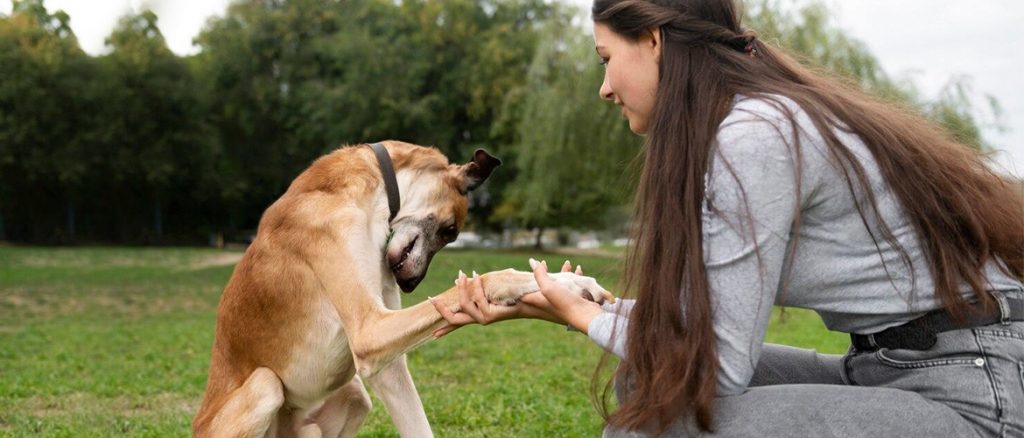
Welcoming a new furry friend into your life is an exciting journey filled with wagging tails, wet noses, and boundless love. But amidst all the cuddles and playtime, it’s crucial to establish clear communication with your dog. Basic dog commands not only help in fostering obedience but also strengthen the bond between you and your furry friend.
Teach your dog to wait at the doors before entering or exiting.
18. Find It
Engage your dog’s natural scenting abilities by hiding treats or toys for them to find.
19. Bring It
Teach your dog to pick up objects and bring them to you, a helpful skill for fetch.
20. Stay Close
Reinforce the importance of staying nearby, particularly in potentially dangerous situations.
21. Go Potty
Direct your dog to poop/pee in a specific location, making potty training a breeze.
22. Be Gentle
Teach your dog to interact softly with people, particularly children or smaller animals.
23. Look Away
This technique aids fearful, anxious, or frustrated dogs in managing reactions to specific triggers like other dogs, strangers, or noises.
24. Chin Rest
Train your dog to rest their chin in your hand, useful for grooming or administering medication.
25. Target
Encourage your dog to touch a specific object with their nose or paw, aiding in training and behavior modification.
26. Free
Release your dog from a command or restriction, signaling the end of an exercise or training session.
27. Jump
Teach your dog to act with the ‘Jump’ command for a playful and energetic training experience.
28. Hi-Fi
Boost your bond with your pup by teaching the ‘Hi-Fi’ command for a playful and rewarding interaction.
29. Left/ Right
Teach your dog Left/Right commands for precision in navigating obstacles or directions during walks or activities.
30. No
Establish boundaries and discourage unwanted behavior with “No” commands in your dog training regimen.
Frequently Asked Questions
1. What is the best age to start teaching my dog commands?
Start immediately! Puppies can begin learning simple commands around 7-8 weeks old. For adopted adult dogs, start on the first day. Keep sessions fun, short, and use positive reinforcement.
2. How long should training sessions last, and how often should I train?
Keep sessions short (3-5 minutes) and frequent (3-5 times daily), especially when teaching new commands. Short, positive sessions prevent boredom and allow your dog time to process the information, leading to better retention.
3. What is “Positive Reinforcement,” and why is it important?
It means immediately giving a desirable reward (treat, praise, toy) when your dog performs the correct behavior. This effective method builds confidence, strengthens your bond, and increases the likelihood of the behavior being repeated.
4. My dog knows the command at home, but ignores me outside. Why?
This is a lack of generalization or proofing. Systematically practice the command in various locations (proofing). Gradually introduce the 3 D’s: increasing Distraction, Distance, and Duration until reliable.
5. How long does it take for a dog to learn a new command?
Simple commands like “Sit” can be learned in 1-2 weeks of consistent practice. Advanced commands like “Stay” or “Heel” require several weeks to a month or more to become reliable, especially under distraction.
6. Which three commands are the most important for safety?
Answer: The three most crucial for safety are: “Come” (critical for recall from danger), “Drop It” (prevents swallowing dangerous items), and “Leave It” (stops them from touching forbidden items initially).
7. How can I use the “Go to Bed” command to stop attention-seeking behavior?
Use this command to manage inappropriate attention-seeking (jumping, barking). The bed becomes a rewarding place to be. It teaches them to settle and provides a constructive, calm, alternative behavior.
8. Is it possible to teach an old dog new tricks?
Yes, absolutely! Adult dogs often have better focus and routine than puppies. You may need to adapt training for physical limitations, but the desire to earn rewards means they can easily master new commands.
9. What is the difference between “Stay” and “Wait”?
Stay is a formal, long-duration hold requiring a release word. Wait is an informal, temporary pause used primarily at thresholds or before food, teaching quick impulse control before an event. Hope these 30 basic dog commands lay the groundwork for a harmonious relationship between you and your furry friend. With time and dedication, you’ll not only have a well-behaved dog but also a lifelong friend who understands you.